Monday, October 30, 2006

October Revolution 3: Economics

The famous German economist, Max Weber, proposed the connection between Christianity and Free Market labor almost one-hundred years ago in The Protestant Ethic & the Spirit of Capitalism. In particular, he noted the industriousness of the Puritans (Calvinists one and all) as a psychological incentive that helped fuel Capitalism. Their sense of Christian vocation for any lawful endeavor in life coupled with their sobriety, thrift, stewardship and high ethics contributed greatly. Twenty years later, R. H. Tawney argued similarly in his Religion and the Rise of Capitalism.

Furthermore, the Reformers allowed the proper use of interest for money (contrary to Romish practice) and the accumulation of wealth for families and their children’s children. This further stimulated capitalism.

“Without question, the doctrine of Calvin, in so far as it concerns lending at interest, ran counter to the doctrine of the Catholic Church. This was because Calvin did not believe in barriers between the spiritual and the temporal: he considered work and the serious exercise of a profession as praiseworthy, and therefore accepted the acquisition of riches as legitimate…” (39, Modern Capitalism: Its Origin and Evolution, By Henri Eugène Sée, Ayer Publishing, 1968.)

Again, since the kingdom of God was wherever the Christian’s vocation in life was, those lawful activities of work and recreation were sanctified unto God. It was not sinful per se to accumulate wealth nor seek after prosperity. Although, given no biblical guarantee of prosperity (see Job), the believer knew that the biblical ideals of hard work and thrift generally lead to plenitude. They were following biblical precept by observing the industrious ant.

And in the spirit of true mercy, the office of deacon flourished in the Reformed churches as well, helping those in economical need. Mercy and money could coexist.

Historian, Lewis Spitz (The Renaissance & Reformation Movements, Vol. II, p. 557) summarized thusly:

“…by instilling into the laboring classes a view of life that raises work from drudgery to a source of self-respect, Protestantism and especially Calvinism helped to build up a group of productive and reliable people, a solid base for a capitalistic society.”

The believer was economically free.

Thursday, October 26, 2006

October Revolution 2: Religious

Calvinism has been given a bad name in the modern and postmodern eras. As some of the students at the college ministry observed, in the classes that mentioned Calvinism, they always explained it as an obscure glad-its-gone doctrine of a bygone age. It is purportedly a “rigid” system of doctrine; it breeds “dour” people; and it had that “horrible” belief of predestination. As Voltaire spoke of Calvin himself, so many think of his doctrines: “He was acquainted with Latin and Greek, and the bad philosophy of his time. He wrote better than Luther, and spoke worse; both were laborious and austere, but hard and violent…” (Schaff, Vol. 8, 277).

In the following posts, the tremendous impact of Reformation theology will be presented. It was not the only source of influence, but it was of great significance in the economics, sciences and politics of yesteryear and the roots of modern prosperity. Of course, history is not accomplished in a vacuum, the Reformers always insisted that they were only following doctrines already existing in the church but not fully understood or consistently carried out. What I hope to accomplish is a greater appreciation of the results of the Reformation; results, to be sure, that were not necessarily consciously pursued—a not uncommon activity among humans—but logically flowed from the biblical ideals of Luther, Calvin, Bullinger, and their fellow Reformers.


Church

In the first installment, I summarized the core doctrinal effect of Luther’s 95 Theses, justification by faith alone. Human mediation was removed. Thus, the hierarchy of Rome was rejected. This lead to the doctrine of the priesthood of the believer: each Christian had immediate access to God through Christ alone by faith alone. No human instruments (sacraments, saints, or priest) came between the believer and Christ. This liberated the individual.

Luther also translated the Bible into German instead of following the tradition of Rome which only used the Latin Vulgate and that only by trained experts. Since Rome believed that salvation was found in the church (through her accumulated merit) and church tradition was on par with the bible, it followed that the church would control the bible. Again, the priesthood of the believer gave immediate access to the bible since it was there that Christ was found. Literacy abounded.

The priesthood of the believers also affected the church directly. Since the ministers were not priests in the strict sense of the word, but ministers (servants) for the church and for that salvation immediately obtainable to the individual, then hierarchicalism was greatly hampered. In the Reformed churches of Calvin & Zwingli, this top-down structure was abolished. Congregational songs, voting and discipline was revived accordingly.

The priesthood of the believer also gave rise to liberty of conscience. A man with a clear conscience is a man with liberty. The freedom to believe and worship God according to the Bible was a strong impetus in France, Holland and Scotland, leading to societal changes in those countries. Although, as with most revivals, there was not a perfect implementation of this idea, it still shook nations.

The priesthood of the believer arose directly from Luther’s view of salvation. Since justification (our right standing before God’s law court) was only through faith and only on account of Christ’s righteousness alone, then no mediating person or institution was needed. Society’s structures (home, school, guilds, etc) were no longer playing second fiddle to the Romish church. Monkery was rejected and a full marriage life was embraced. Holy days were abolished and time was freed. In other words, the Kingdom of God was no longer limited to the pope and his church. It was a broader kingdom, embracing all of life sanctified to God.

Christians are priest, so they are to dedicate all endeavors to God. Christians are prophets, so they are to declare the truth in all endeavors of life. Christians are princes, so they are to dominate all endeavors for God’s glory.

Justification by faith alone changed everything.

------------

Naturally, many reading this series of articles may think it rather prideful, arrogant and self-serving. So, to prove my point I have attempted to cite secular, non-Christian if not non-Calvinist sources to prove my point. The rest of the proof is in the logic presented.
[Next: Economics 101]

October Revolution: Luther vs. Halloween

What is the difference between Martin Luther & Halloween? Only one of them changed Western Civilization. This special edition is given out of a desire to fan the flames of Reformation in our hearts and lives. Today it is easy for Christians to lose sight of the power of the Gospel by dwelling on the politics, economics and wars of today. Hopefully, we can turn our eyes on Christ. And one way to do that is to recall the great acts of our spiritual fathers and demonstrate the breadth of impact that they made by the power of the Spirit.

----------------------
Happy Reformation Day

What is the significance of Luther’s break with Rome? Many Christians would readily acknowledge that Luther brought back free Gospel grace and freedom from the tyranny of Rome. But what exactly does that mean? Did Luther’s rediscovery of the Gospel only affect individuals? How did it change the world? Hopefully, this short series will open your eyes to the greatness of God’s work over 480 years ago.

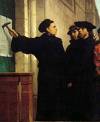
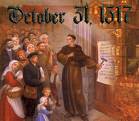
On October 31, 1517, the eve of All Saints’ Day, an Augustinian monk, hammered 95 theses—short propositions—on the Wittenberg door in Germany. He was protesting the indulgences of Tetzel, who, purportedly announced: "As soon as the coin in the coffer rings, the soul from purgatory springs.” This system of indulgences was part of the larger system of baptism and penance and the Mass. Each a step in the works-salvation method of Rome. If a shrewd Christian could find the right confessor and some money, he could cover most sins while living like the Devil. In fact, even civil punishment could be avoided this way (Works of B. B. Warfield, Vol. IX, Studies in Theology, “The Nintey-Five Theses In Their Theological Significance”, p.497).

Hammering the thesis was a public declaration. An advertisement of sorts.

But it was more. It was a formal declaration against the Papal and Romish supremacy in matters of faith and life. The various theses fundamentally attacked the Romish church’s authority over the matter of salvation. It dismantled the churchly machine of Sacerdotalism—that mechanical view of redemption integrated into the church. It was claimed that salvation was found only in the Romish church through the Romish priests and the Romish sacraments. Good works were instrumentally necessary for salvation. In short, it was a works-salvation system. And although Christ was formally part of the process, He was not part and parcel to the entire schema.

In contrast, Luther wrote: “Every truly repentant Christian has a right to full remission of penalty and guilt, even without letters of pardon.” (Thesis 36). That is, Christians can have full remission of sin without Romish interference (“letters of pardon”). The believer had direct access to God. He needed no other mediator than Christ. Warfield explain the antithesis thusly:

“The fundamental difference between the two doctrines [Luther & Tetzel] is the fundamental difference between evangelicalism and sacerdotalism. Evangelicalism casts man back on God and God only; the faith that it asks of him is faith in God’s saving grace in Christ alone. Sacerdotalism throws him into the hands of the Church and asks him to put his confidence in it—or, in the indulgences, very specifically the Pope.” (ibid, 499).

This view was summarized by Luther: justification through faith alone, by grace alone on account of Christ alone. It was a view that was earlier discovered by Luther’s study of the book of Romans (about 1515 AD). And it is the view underlining the 95 Theses:

“What he here attacks is just the sacerdotal principle in one of its most portentous embodiments—the teaching that men are to look to the Church as the institute of salvation for all their souls’ welfare, and to derive from the Church all their confidence in life and in death. What he sets over against this sacerdotalism is the evangelical principle that man is dependent for his salvation on God and on God alone—on God directly, apart from all human intermediation—and is to look to God for and to derive from God immediately all that makes for his soul’s welfare. In these Theses Luther brought out of the academic circle in which he had hitherto moved, and cast into the arena of the wide world’s conflicts, under circumstances which attracted and held the attention of men, his newly found evangelical principle, thrown out into sharp contrast with the established sacerdotalism. It is this that made the posting of the Theses the first act of the Reformation, and has rightly made October Thirty-first the birthday of the Reformation.” (ibid, 511).

[Next: The churchly and societal impact of the Reformation]
(entire series here)

----------------------
“But what things were gain to me, these I have counted loss for Christ. Yet indeed I also count all things loss for the excellence of the knowledge of Christ Jesus my Lord, for whom I have suffered the loss of all things, and count them as rubbish, that I may gain Christ and be found in Him, not having my own righteousness, which is from the law, but that which is through faith in Christ, the righteousness which is from God by faith.” Phil. 3:7-9

SDG

Monday, October 16, 2006

Christian Tribalism IV: Remedied


1 Corinthians 1:12 speaks directly to this issue of Christian tribalism:
For it has been declared to me concerning you, my brethren, by those of Chloe's household, that there are contentions [divisions] among you. Now I say this, that each of you says, "I am of Paul," or "I am of Apollos," or "I am of Cephas," or "I am of Christ." Is Christ divided? Was Paul crucified for you? Or were you baptized in the name of Paul? (11-13).


Thus, there was tribalism—“exaltation of the tribe [shared interests] above other groups”—an emphasis on distinctions implying an attitude of superiority—in the church at Corinth. Paul reprimanded this radicalization of distinctions. Unity and harmony should be the goal and activity of any church (local or regional) (Eph. 4:1-3). Men should not be the center of group-focus, rather the group should look to the base commonalities with the larger community in which it relates.


Not only should undue separation in doctrine and deed be avoided, mutual submission should be practiced (cp.1 Pet. 5:5).
Now I plead with you, brethren, by the name of our Lord Jesus Christ, that you all speak the same thing, and that there be no divisions among you, but that you be perfectly joined together in the same mind and in the same judgment (1 Cor 1:10)


In this passage we have the opposite of church-tribalism: internal and external unity. Internally we should be of the “same mind”—the same thought patterns, goals and ideals. Hence, the church is an organism. Externally, we should speak the “same thing”—the same confession, not merely in creed but also in deed. Hence, the church is an organization.


What this means is that as a member of the church, we should strive to submit to the greater unity of that church (locally or regionally). What this does not mean is a lost of identity in function or personality (1 Cor. 12). There is diversity within the unity. We will have differences (raising children, political practices, apologetic techniques, etc.), and even shibboleths (raising children, political practices, etc) but unless they are clearly in the Word and rise to the occasion of separation, they ought not to become issues. They ought not create a tribal-mentality in which that group of people and its goals, intents or ideals becomes greater than the whole of the church.


Is This Not Obvious?


It is not.


It takes much prayer. It takes discipline. It take humility. A ready admittance that "my way" is not always the best way. And even if it is the best way--so what?


Let us not forget Paul's admonition to the Romans:
"Receive on who is weak in the faith, but not to disputes over doubtful things...Therefore let up pursue the things which make for peace and the things by which one may edify another..." Rom. 14:1,19


Unity is little practiced in America. Even in Reformed and Presbyterian churches. Even within the same denomination! It seems at times that each church lives its own life in isolation from others. If this is unhealthy for individuals and families, then why not for churches? No church is an island.


We have to think outside our own selves, families and churches. We have to strive toward the unity that Christ bled and prayed for. We have to begin with humility and repentance from egotistical isolationism.


To defeat tribalism and to avoid being another illustration for blogger fodder, we must change our ways. And love one another, esteeming others higher than ourselves.


Pray that the Spirit would be pleased to do just that.


SDG

Friday, October 13, 2006

Christian Tribalism III: Illustrated

Proof is in the Pudding

We find some tribalism in the state. The state obviously manifests this infestation through the increase of special interest groups, compartmentalized bureaucracy, and fragmented visions of unity amongst the political parties (conservative Republicans, Reagan Republicans, Rhinos, neocons, etc.). Parties preach to the choir or yell at each other. There is no true dialogue. Our American system was purposefully built to be institutionally fragmented (three branches of government, bicameral legislation, etc.), but with the understanding of a common ideological underpinning. The former still exists, yet the latter exists is quickly fading. The center will eventually collapse with tyranny or anarchy as the result.

We find tribalism in the family. Whenever a family is suspicious of other families because they are not quite in line with their approach to life—whether in thought, word or deed—it may be tribal infestation. Whenever a family moves from church to church because they are “uncomfortable” with this or that of the church, it may be nomadic tribalism. Whenever a family teaches it own—verbally or non-verbally—that they themselves are virtually self-sufficient from other individuals, families or churches (even of society as a whole), it may be tribalistic egotism. It becomes family against family. A form of shunning may arise or gossip may be perpetuated to further reinforce group-think. They withdraw into themselves and only associate with those of the same core convictions—convictions not intrinsic to the Gospel of Christ. Rather, they are convictions rooted in legalistic shibboleths and antinomian idiosyncrasies. Eventually, it may mutate into a home-church: spurring any and all ecclesiastical bodies save itself.

We find tribalism in the church. Doctrinally (ideologically), people—even officers—have variations of beliefs and depending how tight they hold these beliefs they may be susceptible to tribalism. Differences usually do not surface until there are practical consequences. And differences usually begin in teaching hobby-horses and magnifying secondary and tertiary doctrines and practices. Communication between other churches is minimal because suspicion already exists, begetting less communication. Such emphases create homogenous churches (witness the church-growth movement). Does a church isolate itself collectively and familialy from other sister-churches? Does it not participate in other church's activities? Does a church unduly emphasize a person or position? Does a church preach unique views that result in pride and segregation? Does a church remain ignorant of its identity and relationship with others? If so, then there may be a bad version of tribalism afoot.

[Next: Remedy]


Monday, October 09, 2006

Christian Tribalism II: Defined

To understand this fragmentation and balkanization, tribalism must be defined. Webster summarizes thusly: “exaltation of the tribe above other groups” [or “strong in-group loyalty,” Webster, 11ed.]. In its more extreme forms, tribalism results in not only practical isolationism, but formal separation from the larger body. Now separation is a natural characteristic; many sub-groups, cultures, clubs and the like exist in America and have always existed.

Naturally, the church exercises a type of separation, but in a biblical manner. The church exalts Christ above all. It should have “strong in-group loyalty”—loyalty to Christ and to each other. Thus, in this sense the church is tribal with respect to the world, the flesh and the devil. The church is to be theologically isolated and cultural different (but not isolated completely). It draws its membership from the tribes of the world to be one (Rev. 5:9).

Tribalism in a negative sense means that prideful adulation of the sub-group over and against the larger group in which it exists. It thinks “we are better”; it says “we have a better approach”; it does its own thing in spite of the concern of the larger group. It is collective self-centeredness. It is rude and unkind to the very body which gave birth to it. It thinks of itself first and foremost and may consider others, if convenient.

Since the church-militant struggles with sin this side of eternity, there are many tribes within her—differing denominations. This is to be expected. And mature members and churches will handle such differences in love and rectitude. Such differences cannot be avoided, but they are aggravated when those groups or churches within a denomination begin to unduly exalt their groups interests, goals or ideals. Shibboleths arise; idiosyncrasies predominate; ecclesiastical isolationism ensues.


From this definition, the extent of tribalism may be more appreciated; it infects the political realm, the churches and even families. Clearly, any bible-believing Christian knows that pride—whether individual or collective—is wrong. Pride is more obvious in group situations because the number of prideful individuals is multiplied, creating a greater negative impact on others. However, it is harder to extinguish as well. The old saying that “birds of a feather flock together” has much merit and such a fact reinforces the group-mentality of tribalism: isn’t everyone else in my group on the same page? But the real question becomes instead: is this same page biblical? Should I or my family or my church make such a stand as to virtually place this page above the larger book of commonality found with other belivers?

[next: What it looks like]

Friday, September 29, 2006

Christian Tribalism I: Resurgence

I recently perused the latest edition of Wired. The article, “The Rise and Fall of the Hit”, caught my attention. It was an intelligent digest of how technology has recently mutated our relatively unified cultured (via the industrial revolution) into a niche market—a market more readily designed for organization around shared interests. Technology was decentralizing the culture.

In Neil Postman’s book, Amusing Ourselves To Death, he worried that the television would be the great unifier and sustainer of mass pop culture—a culture driven by the fragmented and disjointed running images of the boob-tube instead of a culture rooted in the coherent and rationale realm of the written word. His concern was that our culture was becoming more insipid and lackadaisical in its thinking processes, being fed instead with inane sound-bytes and drowning in a sea of amusement.

Neil is correct about the sea of amusement. What Neil had not realized (at least through that book) was the coming tribalization of America--a hi-tech tribalism. Technology further facilitated rising multiculturalism and fragmentation. Age-groups dominate the social scene with the Gen Xers emailing over vast distances while their Boomer parents complain about Gen Yers who text-message. Groups geographically isolated now connected through individual and mass media to further their agendas. People no longer are American or Anglican, they are Asian-American or Green-Anglican, creating new categories of differentiation that accelerate the sub-group’s distinctions from the larger community in which it dwells.

Another name for this effect is Postmodernism. With no epistemic-center in the system of many contemporary philosophers (otherwise known as post-structuralism), and especially the lack of self-reflective thought in most Americans, balkanization in American ideology and theology was sure to follow. Technology further enhanced such an approach through the individualization of tastes: don’t like what’s on the tube? Watch your own streaming video. Finding the radio to boring? Listen to your MP3 player instead. Is the local church too humdrum? Choose your pastor on cable or online.

Thus, technology has connected people who would have otherwise been separated geographically and economically. We can talk for pennies on the dollar with those we’ve never seen and we can disseminate our views with wider audiences via blogs. Hobby-horses connect world-wide with sympathetic ears; church members follow sly blogged innuendoes instead of their own church leaders; families withdraw from local friends as they connect with those far away; ministers grow distant with their own presbyteries while bonding with outsiders. In short, we begin to fragment and tribalize.

And this modern balkanization has wormed its way into the various God-ordained spheres of life: family, church and state. It has existed in small forms over the centuries (compare Anabaptists & some Fundamentalists) and, through the help of current technology, is in resurgence today—albeit in more subtle forms.

[Next: What it Is]

Monday, September 18, 2006

A Short Review 8: Ready to Restore

Ready to Restore: The Layman’s Guide to Christian Counseling, Jay Adams

The subtitle says it all: this is an immanently useful and practical book for anyone desiring to grow as a Christian. Why do I say that?—Because we are all commanded to admonish one another in the Lord and to bare one another’s burdens (Col. 3:16; Gal. 6:1-2). This, of course, is what every good and faithful friend desires. And Adams supplies the guidelines and principles straight from the Bible for every believer’s use.

With the relatively large number of chapters and small font, this book may intimidate some and turn away others, yet Jay Adam’s irenic and simple style is conducive for a quick read—especially on a chapter-by-chapter basis. The author first starts out with the basic questions about who should counsel and what counseling actually entails (chapter 1-3); he then encourages the reader that he can and should learn to counsel (4). Chapters 5-14 are the heart of the book, expounding and explaining the details of a biblical and practical approach to counseling. The remaining chapters focus on the counselor’s own growth and any typical questions and problems one may face in a counseling situation.

Amongst the many useful aspects of this book are the twenty-five basic counseling principles (p.32), the analysis of ‘self-esteem’ and the Biblical corrective (p.55) and the simple two-fold solution to problems: helping someone out of a problem and keeping them out of the problem (p.57).

Ready to Restore is an excellent book for every believer in Christendom. In trying to teach yourself Biblical and Reformed counseling, you not only help other through their difficulties you learn to grow in Christ as well.

Monday, August 28, 2006

Man is Evil—Lessons From Katrina Part 3

Homosexuals throw a street party while thousands suffer.
Corrupt politicians ignored the levy problems for decades.
Now they promise to help those whom they destroyed.
Looting occurred almost instantly.
Rescuers were being attacked and harassed.

There are one million and one examples of the wickedness of man. The refuges are angry, bitter and irate. As they lash out at the local, state and federal governments, they rage not against man but against God. God is in control. And the government is not God. No matter how prepared they could have been God’s will would have been accomplished.

Seeing the awesome might of Almighty God brush the Gulf Coast away as a sun eradicates a moth, they acknowledge Him not but flee to man for refuge. Such an event is to show God’s wrath and man’s sinfulness. It has done both. But the church also has a job to proclaim these truths. Instead, as the American churches are wont, they send monetary help without Gospel help. They shy from uttering dark pronouncements lest they appear “negative”. They shirk their prophetic responsibility being uncomfortable with the prophets of old:"The heart is deceitful above all things, And desperately wicked; Who can know it?” (Jer. 17:9).

According to the buoyant proclamations of the likes of Sean Hannity (a Roman Catholic), these devastations were to bring the “best out of the American people.” But if one examines a little closer with the eyeglasses of the Bible, one rather finds the manifestations of evil: men and women shaking their fists at God while helping their fellows rebuild their engines of destruction against the Kingdom of God.

If the churches in America would be true to their calling, then as servants of God they must, “in humility [correct] those who are in opposition, if God perhaps will grant them repentance, so that they may know the truth, and that they may come to their senses and escape the snare of the devil, having been taken captive by him to do his will (2 Tim. 2:24ff.).

They will not feel sorrow over their rebellion if they believe there is nothing wrong.
They will not cling to Christ if they believe themselves good.
There are one million and one reasons why men should repent. The obvious and easiest reason is the first one: man is evil.

SDG

Sunday, August 27, 2006

The Government Is God?--Lessons From Katrina, Pt.2

Sometimes how people react to problems shows who or what their God is. When trouble comes, where do people go for help? Help not only for psychological and spiritual issues but also physical help.

So, where did thousands turn when Katrina hit? Did they take their saving and fly out of the city? Did they hitch a ride with friends and family? Did they stock up on food and water to sustain themselves for days?

The answer is obvious: when trouble came, many people turned to the government for help. They turned to governmental monies as their savior.

But the help did not come in time. That is why they are angry and frustrated: their god did not come through for them.

From another angle one can find out who or what god is followed by the amount of responsibility given. In God’s Word, He has separated the authorities of life into three main spheres: family, church and state. Whenever one institution usurps or expands its authority, it is claiming autonomy instead of submission to God. It’s just like Adam who desired to follow his own ways instead of God’s Law.

It is interesting to note that an ABC news report with Dan Harris (reporting, 9-6-05) stated that the city had a plan, but implemented it too late (it specified offering free transportation out of the area, but people were sent to the Dome instead); at the state level the governor is supposed to specifically ask for help from the Feds—but she did not. And of course, FEMA had its problems. The mayor blames, the State and Feds; the governor blames the Feds and the Feds will gladly take more responsibility from these institutions! The president did take responsibility; the mayor and the governor have not. And of course many people took little to no responsibility about their welfare.


(As of this date, more fraud in FEMA has been discovered as well: "through February 2006, FEMA made about $1 billion in improper and potentially fraudulent payments." Well, every god has his tithe...)

Now, billions will be poured into an area where insurance companies do not cover floods and hurricanes (why would they—they’d go broke!) and people will become more dependent upon the government.

In America, for many people the Government is god. So, the next time a large-scale devastation occurs, the Feds will sure to be there, comforting their flock.And taking more responsibility.

The churches must be faithful & warn people about this danger. Let's pray that many will learn, repent and turn to Christ. The Lord He is God and not the government.

SDG

Friday, August 25, 2006

Blame It On God—Lessons From Katrina, Pt. 1

In the one year anniverary of Katrina, the great gurus and thinkers of America rattle off many and sundry lessons learned from that terrible time. Movies and documentaries (I use the word loosly) are being shown as well. blaming the government, the infrastructure or that long-standing incipient evil in the hearts of everyone else but the accuser: racism. I suppose, knowing Americans, that some church somewhere is also preaching on this topic. I republisih this three part-series in the hope that others will find the real reason for this disaster.
----------------------

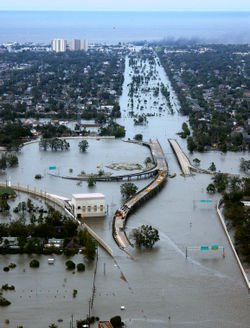
Thousands are presumed dead in the Gulf Coast area.
Hundreds of thousands are stranded in New Orleans.
Millions, if not billions, of damage wrought in one storm.

And people are asking, “Where is God?”
Anger bubbles from deep within the souls of thousands of angry people: “What kind of God allows this!” They are blaming God for the disaster.

And they should. He did it. He controls all things in creation.

But why?

Some talk show hosts try to calm people down by reversing the question: “Why has God blessed America all these years?” Or they wish not to speculate at all, glibly replying, “We need to help one another and bring the best out of the American people.”

However, Christians know that all things work for their good and for God’s glory (Rom. 8:32; Rom. 11:36). Furthermore, we know that since there are no longer prophets today, we must be careful in our evaluations.

But this is not all: Christ informs us of at least one reason why bad things happen:“Or those eighteen on whom the tower in Siloam fell and killed them, do you think that they were worse sinners than all other men who dwelt in Jerusalem? "I tell you, no; but unless you repent you will all likewise perish." (Luke 13:4, 5).


When such disaster strikes—contrary to some misguided caller to the Medved show—its not because New Orleans was more wicked than San Francisco; one reason for disasters is to bring a wake up call to mankind: the world is full of sin and sinners; we no longer live in paradise.


Americans like to think that God is far away and irrelevant in life. Any prosperity gained is credited to ourselves; any advancements in life is honored to lady luck. Yet when things go bad and calamity knocks on our door—suddenly, it’s God’s fault.

In reality, as Jesus points out, everyone sins—all rebel and hate God, seeking their own desires and following their own lusts (Roms. 1:24ff.). The tower did not fall on some because they were more sinful—it fell because they were sinful. Period.

This is a wake up call. Americans better repent or they will perish.
And they’ll have no one to blame but themselves.

Tuesday, August 15, 2006

God's Smuggler & A Cranky Calvinist

Bemused

My wife recieved an unexpected surprise last weekend. Cheap books. She likes to peruse the dime-priced, used books at the local library--a favorite pastime of those with Scots-Irish frugality rushing through their veins.

It turns out that one of the books was a biography of a bible smuggler during the Cold War of the 1950s. At first I did not recognize the book. So my wife bought it.

And she read it, explaining to me the interesting history of this man named "Brother Andrew". He was raised Dutch; survived WW II; and abandoned his upbringing.

Then the book got interesting: after a bitter experience in the Dutch army resulting in a foot-injury, he began to seek God. He was healed, decided to seek the ministry outside the Reformed tradition he was reared in and ignored the advise of a sweet Dutch girl concerned with his new mystical direction in life.

And then the novel went down hill from there--as far as my wife was concerned it went absolutely weird. Charismatic weird, that is.

For you see my wife was raised Reformed most of her childhood. I, on the other hand, was reared Charismatic--speaking-in-tongues, slain-in-the-Spirit, lay-the-'ol-fleece-before-God, die-in-the-wool, Charismatic.

Old memories rushed into my soul, recalling the confusion and struggles of my childhood religion. Accordingly, I suggested to my wife: "Dear, if you can read this book, then you will sufficiently be inculcated into that gestalt known as 'Charismatic'--you'll better understand them" (or some such gentle endorsement).

Cranky

Well, as the days progressed, my wife grew increasingly aggitated, exclaiming, "incredible"; "no way!"; "did that really happen?!". All the while, as she grew more incredulous with every reading of the progressively disturbing Charistmaic antics of yesteryear--random, and
irrational acts: traveling without money; participating in foreign worship without knowing the language; laying the illegal bible right on the front seat at check-points; trying to sell a perfectly good house while having four children and no job--I gave her that knowing smile: "Been there; done that!"

She muttered and grew cranky with the book. Never having met, let alone heard, someone with such improbable events, she did not know how to digest the book. Calming down (and against sound advise), she, with morbid fascination slipped into the twilight zone: interacting with a bizarro world where every good, common, providential sense was defenestrated, she plowed through the rest of the novel. She discovered little of Christ and more sensationalism.
Heartless
Naturally, those inclined toward reading these books and thinking in those terms will find this posting rather rude, if not insulting. Surely I must be one of those hard-nose, cranky, heartless Calvinsits!

Indeed I am. A Calvinist that is. I do take exception to being verbally attacked so, but I'll get over it. I do love my brethren outside the Reformed faith. That is why I try to woo them to a better path.

With the vast majority of Charismatics (sometimes called Pentecostals) denying God's providential control of all things, they naturally gravitate toward the miraculous. The mundane just won't do; God is not in the details of life. Besides, to think in a common-sense way was almost to succumb to the "flesh".

If God does not predestinate the means as well as the ends, then He must be found in other ways. He must "miraculously" intervene in our lives. Faith was against understanding. Using the ordinary means of life was, at times, almost anathama. At least in the books I read and the circles I travelled.

Having no supernatural, monergistic regeneration in my doctrine of salvation while a Charismatic, I, living in the shadow of classical Protestantism, desired the supernatural in my life. Separating God's work of grace into two-stages, I was not taught to integrate my life with the bland, the bromidic, and the banal.

Preaching was not enough; the ordinary means of grace--from the Sacraments and public worship to Bible studies and fellowship--were submerged in a confused world of hyper-supernaturalism, almost a Christanized Paganism wherein I strived to find God's will in my life and debated whether or not houses or Christians could be demon possessed or if the OT prohibition on owls had some continuing demonic referent (Lev. 11:13).

I was not taught to think. Charismatics virtually have no systematic theology book to claim. If God's revelation is still ongoing outside the finished Word, then anything written could change in a moment of spiritual frenzy.

I claim no heartlessness, but a love of Christ. It is true, that to have all the truth in the world but not to be animated by love is to have heartless doctrine. It is also true that to have all the love in the world but to be sustained in error is to have a lying heart.

We must remember that the saints of old followed the most ordinary precautions, trusting that they would be sufficient because God sustains all things by the power of His Word, while recognizing that God was not limited to such means. Joshua spied out the land (as "Brother Andrew" recognized); Nehemiah set up security while rebuilding the wall (Neh. 4:18); Christ preached when he could have used miracles. The entire Bible is rational discourse and understandable stories.

This is true faith: using that which God commands and promises. He commands common-sense use of our renewed mind (Rom. 12:2); He promises to sustain that very mind for His glory:

"Unless the LORD builds the house, They labor in vain who build it; Unless the LORD guards the city, The watchman stays awake in vain." (Ps. 127:1)

You see, my dear friend, you need shelter, but it won't be built out of thin air. You need God's will, but you must seek it only in His Bible.

SDG
Sunday, August 13, 2006

Mathis Manor 3: Peer Pressure


Yes, through friends and family, I've been pressured to upload more pix. Even though not much more has happened.

But that's ok! Enjoy:


Kitchen from living room perspective.

Here is the living room itself with the never-to-be-used gas fireplace (unless it becomes cheaper!).

Well, eventually someone had to see the bathroom. It was that or another picture of the kitchen.

The time is short and the Lord is great!

Friday, August 11, 2006

Let's Vacation in Iraq While Indiana is Safe

I'm always looking for the silver lining. I don't want to be considered some drab and dour-faced Calvinists and hard-nosed pre-WWII Conservative without a funny-bone in his body. Thus, I am happy to present the following:


Here is some good news from Iraq: The Other Iraq

Here is some good news from American Homeland Security: Why Indiana is Terror Free

See? I feel better already!

(Brought to you by the reliable news network, The Daily Show).

Friday, August 04, 2006

Books Critiquing Federal Vision

I recently perused several book related to Federal Vision and Norman Shepherd. Specifically, I glanced through two (with my hard-fought speed-reading abilities from high school) and read carefully through two others. I would like to summarize them so as to get the right books for the right audiences. (For the record, I have read articles and heard lectures by FV proponents as well.)

There is much out there (especially on the net) and many pastors, let alone laymen, have little time to read all of it. I hope this is helpful (with unwitting help from Dr. Coppes who read the first two books and verbally summarized them to me):

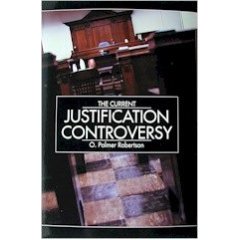
1. The Justification Controversy, O. P. Robertson.
The very same author that brought us the popular "The Christ of the Covenants." If you want to read a book on the history of the controversy surrounding Norman Shepherd, than look no further than from a man who was right in the "thick of it." If you can make it through the historical detail and chronology (most of the book), you will find the summary of Shepherd's thinking most enlightening. This is only for those really wishing to find the history behind FV (who invited Shepherd to their Auburn conference).

2. Danger in the Camp, John Otis. This hard hitting book leaves no punches pulled. Using "no holds barred" approach to FV, Otis lays out in this thick tome a host of relevant full-length quotes (we're talking 1 full-page at times) from both FV proponants and confessional standards and authors of yesteryear. This is the type of book that will set the teeth of FVers and those sympathetic on edge.

3. Auburn Avenue Theology, Brian Schwertely. Originally Brian wrote several
articles about FV. This book is apparently a collection of those, but one would not know this given its seamless nature. Although not as strong in his language as Otis, Schwertely deals directly with the key problems of FV. The book gives good, strong and extensive critiques of FV on covenant and justification as well as good, strong and extensive defenses of the orthodox views. His extensive treatment of the theological and exegetical necessity of the active obedience of Christ is worth the price by itself. This book is recommended for all laymen and pastors. He is to the point without being exasperating or strident in his analysis and critiques.

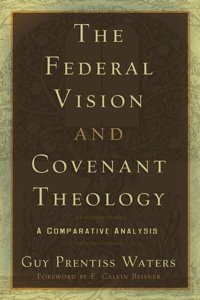
4. The Federal Vision & Covenant Theology, Guy Waters.
This is a companion volume to Waters' previous work, Justification and the New Perspectives in Paul. This is the book recommended by all the scholars. It is written for scholars (although he tries to write for laymen) and it is for scholars. That is, he is not as "straight up" (i.e the difference between saying "that's wrong" and "that is incompatible with our belief system") as say Otis nor as direct as Schwertely, but he makes up for that in his steady momentum throughout the book. It has the largest bibliography, especially garnering resources off the net, showing some incredible quotes not found in the other books (Dr. Coppes has not seen them there either). This book supplements Schwertely by supplying more nuanced analysis and useful quotes and observations. It is recommended for those really wanting to "cover all the bases."

In short order, Lord willing, I will collect the more useful information out of Waters' book (especially since I can link them from the net) for everyone out there. And hopefully a useful introduction to the FV will be forthcoming. The issue is surprising complex for many a laymen. As an educated layman queried professor Strange at our conference: "how can they have losable baptismal regeneration and believe in eternal election at the same time?" He, being well trained by his pastors over the years, could not conceive of such a hodgepodge theology. Indeed, many in the pew could not have either. But, then, these views did not arise from the bottom-up, but rolled down hill from the pulpits.

SDG

Sunday, July 30, 2006

Picking on My Friends

I recently preached on church unity and how we should consider the church of God our family and we as parts of that Body supplying each other's needs (Eph. 4:16). And although blood may be thicker than water, faith is thicker than blood.

As a family, of course, we have immediate relations and remote relations. I used an illustration of a friend from Boise (he knows who he is). He was a friend of a friend, but the fact that we are in the same national church (denomination) makes him a relative---kinda like a cousin. But with more commonality than I would have with any cousin in my family!

I used his name in the sermon, referencing his unique facial arrangment (you can see him in the latest New Horizon). I hope he doesn't mind. I even put in a good name for him.

I like to pick on my friends because they can handle it. And Hobart has large shoulders.

SDG

Tuesday, July 25, 2006

What Up Wit' Dat?

If we can shred the English language, if we can ignore basic logic, if we can feel good about theology (whatever its truth), if we can entertain people into heaven, if we can ignore God's commandments, if we can meet people's felt needs......................

Then why not drop little annoyances in the church?

Like that stumbling block,

Baptism.

We don't need baptism for church membership, right?

Then, in good ol' fashion American thinking, we should put it up for a vote!

Baptism as Requirment for Membership Set for Vote !!!

Now, what up wit' dat?

Monday, July 24, 2006

FV Critique Commended by General Assembly of OPC

As many are already aware, the General Assembly commended the critique of the Federal Vision written by her committee.

But what does that mean? Let the Prefatory Statement speak for itself:

"In commending the report for study, the Assembly approved the content and reasoning of the report. The Assembly did not take any action to endorse every word of the document or make the report itself a part of our constitution (which would have to be approved by the General Assembly and presbyteries in the manner provided in the Form of Government for the amendment of the constitution); nor was the document written with that purpose in mind."

I know some in other sister-churches and those symphatic to the OPC may wish a different approach but this is how such issues are normally tackled here. This report is commended to the Presbyteries. It was requested that the sesssions, churches and Presbyteries be "proactive" in dealing with this issue. Some have already been doing just that (Providence OPC, Denver).

If there are those in disagreement with the Bible and the Standards on such a serious manner as justification (and like related issues as rightfully noted in the report), they ought to change their minds or leave. If some are found out of accord, then they will be gently admonished to change their views in line with the Word of God. If they do not, charges may follow.

As I understand the GA and the report (as I was at GA), we are basically rejecting this new paradigm. And we are warning everyone accordingly.

This is no little matter. Some are saying that our justification depends upon our faithfulness instead of faith alone. Others are saying that those truly sanctified, forgiven, etc. can lose their salvation. (More will be said latter; see here for more info and critiques).

May God protect our small and weak Church.
May she depend upon Christ and His righteousness alone. Amen.

[Here is the OPC report access; here is the actual PDF report].

Cingular-ly Confused

That's right. I've never had a cell phone.
Why should I ever had one? It would mean talking more and doing less. But I digress.

I finally did buy one after much consernation and confusion. Should I buy a monthly plan or pre-paid? Should I go for many hours or less? A fancy phone or a simple one? Special weekend minutes or nightly minutes? Which company? Cingular? Jump Mobile? T-Mobile? Verizon? Sprint? Virginmobile? Net10? ??!!?!

So many choices!! I was truly confused.

I finally realized that the cell phone is a tool and not a toy (but it could be). So, what did I truly (and not in my own depraved imagination) needed it for?

For starters, being between homes, I had no phone! I also plan on getting a land-line at my new house. So, I need something temporary (maybe) and on the side (after my main land-line usage). Thus, contrary to all my friends protestations ("hey, you pay how much?!?!") I got a pre-paid/pay-as-you-go phone.

Here it is:

Well, almost, mine has the white face. But, as my wife would say, its a "cute" phone (very small).

It is attached to Net10. Which means 10 cents a minute, anytime, anywhere, no roaming and easy refill. I got 300 minutes with it over a 60 day period.

Yes, you'll go through the roof and say "you could've got X, for Y cents a minute!" But you have to understand the function of the phone for me. I rarely used my land line as it was (except for the internet!). So, why buy more than I'll ever use.

Besides it's less confusing then figuring out if its 7pm for evening rates or if I'm roaming. I don't like confusion. Our technology helps too much in that direction as it is.

I'm happy for now...just don't talk to me on my cell for too long. I have to pay 10 cents a minute.

Friday, July 21, 2006

Mathis Manor 2


The house is spacious. It is actually larger than we would originally have liked, but the market in Denver is geared toward the large. That just means we can have bigger parties!

This pic on the left is shot from the living room and shows the dining room and kitchen (see the island?). The main door is on the right and the study is to the left of that door.

My wife is poking her head into the garge. The basement stairs (lower wall) are on the right.

The kitchen cabinets were put in two weeks ago. They are darker than the picture lets on. The builder probably was annoyed with us since we did not upgrade the cabinets, floors, etc. We're too cheap for that!

There is much more space than our old house!

The island counter-top is actually a black base with a bespeckeled pattern. Oh, well, you can't see it too well here. We'll have black appliances to go with it. The island has the sink and the washer.

Below is the view from the master bedroom. They gave us a huge window (I'm not looking forward to paying for the curtains!). However, the view is gorgeous. From the front we have the mountains and the back is an open field (beyond that low fence). From start to finish this house is a blessing from the Lord!

Thursday, July 20, 2006

The Mathis Manor 1


God is a bountiful God. He owns a thousand cattle on a thousand hills.
Indeed, He owns the entire universe.

And out of that abundance, He has graced us with a new house. He sold our old one in 21 days (unheard of in this market); He gave us a temporary rental (an entire house that is on the market anyway for cheaper than a hotel!).

The next set of postings are for my curious family (on both sides) to see what the house looks like. Of course, everyone can sneak a peek! Naturally, we have oodles of pixs. Here are a few:

__________________________________

Above is the house.
Below is the view looking out from the front.


No, those are not clouds behind the truck, nor are they little hills--them there be the Rocky Mountains!!

We have this wonderful view without a premium (around the corner of that house are the houses with a $big$ premiums for location).

But only slightly less better than the view and location is the view and location of my--Lord willing--study!


When sitting down I can see God's great mountains (and any storms approaching!).

I also get my own fancy door for the office:


This is not a double door but a small set of windows. The front entrance is to the left; a u-turn reveals a closet and a 3/4 bath. Going right brings one into the kitchen/dining/living room areas and basement access.

Sorry, no pixs--that'll be the next posting!

SDG



Friday, July 07, 2006

Homeless in Denver

Well, to be more precise we sold our old house but our new house is not finished yet. So, we are between houses. We are living in a rental. To be homeless in the traditional sense would be bad by today's standards.

It was all quite hectic. Packing. Boxing. Rearranging. Moving. I have not done that in a while. My wife has only done it twice before in her life! You can imagine the stress.

On the other hand, I had moved 12 times before I was 18. This is my (I think) 23rd move in my short 34 year existence. I guess I'm slowing down. But I like it.

However, what it means is that I will not have a stable blogging time. I know once a week should not be hard, but it is! (Then there are the more hyper guys like White Noise--whom I finally met in person at the OPC GA. He looks just like his profile).

Of course, living in a rental after 8 years of domicile bliss can easily turn into frustration. So, I must--as always--turn to the Word to remind me that my treasures are in heaven, that this world is fleeting. The book of Hebrews reminds me that, just as my spiritual forefathers of the OT, I am a pilgrim in this world. Heaven is my home.

So, even when our new house is completed my family will still be homeless. And that is a good thing.

SDG

Monday, July 03, 2006

Craig's List is Da Bomb!


I recently discovered the Craig's List.

It is quite amazing for those of you not in the know. For all practical purposes it is a virtual garage sale--for free! Most of the items on the list are free and you can advertise on it for free.

Being a frugal Scot-Dutch Presbyterian family at heart, we could not pass this up. Through it we sold in two days:
a night stand
a small desk
a weight set
a lawn mower (with a bent blade!)

We were down to the last three items today, hoping to chuck them out of the house before we moved this week--the less stuff to move the better of course. Naturally, being a free service people call at the drop of a hat, inquiring about said items. And just as naturally, they do not show up to retrieve the items. Thus, we were stuck with our last three items: metal shelves, skies and the dreaded 7-foot, 70s orange couch (with a floral cover protecting our artistic sensitivities)--the couch that was on the list for four days.

Over these four days we had over 10 messages on our phone. But none were for that couch. One man did call for the couch...and the weight set. Since the set was sold, he was not interested in the couch. Sigh.

This night, however, a quite soul called our house enquiring about, you guessed it, the couch. He wanted it and was willing to pay for it. Having received this beloved couch almost ten years ago for free, we could only give it away in the same manner. The man showed up a few hours later with two other friends. They must have been roomies. Frat boys.

They took that couch most readily. I suggested they take our shelves.
They readily took them as well. Then my wife mentioned her skies.
Guess what. They took 'em too!

God is good! God is great! I thank God for the Craig's List.

It's da bomb.

Tuesday, June 27, 2006

OPC GA: Justification Issue

Saturday and Tuesday the GA passed the following summarized recommendations:

1. That the presbyteries include similar topics listed below in the examination of candidates:
Nature of the Bible
Covenant of Works
Covenant of Grace
Definition of righteousness with respect to justification
Nature of union with Christ
Definition of faith
Difference between faith and works
Definition of justification
Instrument of justification
Ground of justification
Imputed active and passive obedience of Christ
Distinction between justification and sanctification
Nature of the sacraments as signs and seals

2. "That the General Assembly recommend that presbyteries, sessions, and pastors be proactive..." in addressing such teaching like New Perspectives on Paul, Federal Vision and like teachings that "compromise the purity of the gospel."

3. That the Committee on Christian Education:
a) distribute the report to seminaries in contact with OPC
b) post on the OPC website
c) consider publication of the report
"thereby [given the above] commending the report for study."
d) that the Committee write a prefatory statement to explain:
the context surrounding the report, including last GA's resolution
the explanation of what commending a report means.
e) and to seek article critiquing said views in the New Horizons.

4. That the Stated Clerk send the report with the prefatory statement to sister churches.

Thus, the 73rd GA of the OPC commends the Report of the Committee To Study the Doctrine of Justification for study.

In light of the recommendation to proactively address these issue, Providence OPC has already brought the issue to the fore through the last two Spring Conferences informing people of NPP and FV. Further articles will be posted on that church website.

This is a serious issue. Illuminating information about this important issue, especially Federal Vision, will be forthcoming. What it all means is that the GA commends this report on Federal Vision to the presbyteries and to help the presbyteries focus their ministerial exams on the proper questions dealing with the significance of justification by faith. The committee was called to "critique" these view and they have.

Pray for the peace of Jerusalem.

OPC GA: Summary of God's Work

We at the OPC are indeed greatly blessed by our covenant God. This is seen not only at the local and regional levels of the church but also at the larger General Assembly level:

He has given us dynamic Christian education opportunities not only on the internet but in translation as well: there is desire from out of country to translate some GCP material into Greek, Spanish and Portuguese.

He has given us more churches as people seek out the OPC, even from various ethnic groups such as Indonesians. Already, a first in our history, we have about 15 church works with four more in the wings. In fact, a Columbia presbytery wishes to join us!

He has given us great opportunities overseas in Asia, Africa and Europe. We are over the whole world spreading the Gospel and creating indigenous churches.

God is good and great, deigning to bring blessing upon our feeble church.

Praise God!

SDG

OPC GA: Sabbath Fellowship

This Sabbath day I was blessed to attend a sister church for morning worship. I met new people. I meet with old friends. I sung new songs. I heard a new sermon. We worshipped. We prayed. We sang. Afterwards, we ate and fellowshipped on this our Lord’s Day.

This Sabbath day I was blessed along with my roommate. We talked. We compared ideas. We relaxed. I napped (too much talking after hours the other nights!).

This Sabbath day I was blessed to attend evening worship. We had the Lord’s Supper. We had a strong sermon exhorting us toward good churchmanship (1 Tim. 3:15). We had songs. We had blessings.

This Sabbath day I was blessed with sweet fellowship in the evening. A few fellow presbyters gathered and talked of things of God and His creation. We encouraged and challenged one another. We were blessed.

I was blessed that Sabbath day because of God. It is His day and He has given it for us. If we honor Him, we will be blessed with peace of mind and spiritual growth.

This Sabbath day I was blessed with godly fellowship from the broader church.
Thanks be to God.

Saturday, June 24, 2006

OPC GA: It Has Begun

The discussion on the committee's report on Justification and Federal Vision has begun.

Keep us in fervent prayer.

Friday, June 23, 2006

OPC GA: Relevant Data

OPC daily updates.
White Noise updates.

And of course, my blog. Different content same event.

Stay tuned.

Thursday, June 22, 2006

OPC GA: Meanderings of a Tired Presbyter

Well, by God's mercy, here I am in south Chicago as a commissioner of the General Assembly of the Orthodox Presbyterian Church.

For some info on this days events, see White Noise.

For my part: the advisory committee that takes up any issues from the denomination committee (Home Missions) is finished (or should be as the final papers are being read).

Thus, I was able to enjoy fellowship the remainder of the afternoon until supper. We enjoyed the hospitality of the kitchen staff at Trinity which served us a plethera of various and sundry "tastes of chicago": mexican, polish, italian, etc.

Being myself--to whit, not too creative with my palate--i stuck with the italian (although I do like mexican): the chicago-style pizza was good. The cheesecake was better!

Now, being a semi-native Coloradoan, I'm not really into humidity. And it's humid here. Nevertheless, I do appreciate the greenery.
But I especially appreciate the fellow brothers in the Lord willing to take time out to accomplish His kingdom-work. I get to meet those far away, hearing their exciting work in our small part of the body of Christ (someone commented on the OPC being the "pinky").

We are small indeed, as the world counts, but as I have seen these last four GA, we large in our passion to follow the Word of Christ, no matter where it takes us. Even if it means being "small".

I pray we continue down this path by the Spirit's power. And that many would come to the Lord.

SDG

Tuesday, June 06, 2006

666: Superstitious Christians

Today is the day! It's Armageddon. Satan's DAy. 6/6/06

The Omen started today. LaHaye's The Rapture came out as well.

Recently, a Reformed friend informed me that her Christian friend, for fear of offending someone, would not write the date, 6/6/06. Another friend's mother--a Christian--would not let her daughter start work on that dreadful day, 6/6/06. I recently heard over the radio (so it must be true!) that some churches were calling for a world-wide day of prayer to stop the work of Satan on the diabolical day, 6/6/06. Just now, on Fox 31 news, the superstitous views of many American Roman Catholics was summarized.

What more can I say? Looks like the Roman Catholic church still has a lot of influence...

_____________________________________

While crawling out of the confusion of Charismatic Dispensationalism, I ran across this verse:

The weight of gold that came to Solomon yearly was 666 talents of gold 1 Kings 10:14

Given the Dispensational hermeneutic, what are the implications of this verse?
--is Solomon a precursor of the Beast
--is gold evil?
--is weight evil? Perhaps talents?

Give this to your friends next time and watch them chew on this.

SDG

Monday, June 05, 2006

Biblical Literacy?

At one time, while in friendly discussion about God's soveriegnty, I quoted Matthew 10:29 by memory:

"...And not one of them [sparrows] falls to the ground apart from your Father's will."

She replied in disbelief--she had never heard of such. So, I looked the verse up and read it to her. (Naturally, knowing human nature, she was not immediately convinced of God's soveriegnty).

At another time, I pointed out (rather nicely, I hope) to a listener that all men know God but "suppress this truth in unrighteousness" (Rom. 1:18)--again, blantant disbelief was projected right at me!

Well, at times I've wondered whether or not I'm just an odd-ball or maybe I don't have a large enough sample size....? Provedentially, while reading over the Christian Examiner, I noticed this article:

"Every semester at Westmont College, a Christian liberal arts collegein Santa Barbara, Calif., Dr. Tremper Longman [a Reformed professor],an Old Testament professor, hands out a pre-test on Bible basics toassess where his students are.

" 'It's (the test) pretty empty when it comes back," the professor said. "They are pretty illiterate about it, especially theOld Testament. The church is not doing a particularly good job of it,either.' "

This is sad! What more can I say? I will simply quote from memory that oft ignored portion of the bible--the Old Testament: "My people are destroyed for a lack of knowledge...they have forgotton the law and they will be forgotten."


God punishes ignorance.

It is easy to blame all the problems in America on those bad old Pagans. I submit to you that the problem primarily began in the church. And began with ignorance.

Don't believe me...? Here I'll look it up for you:


"My people are destroyed for lack of knowledge. Because you have rejected knowledge, I also will reject you from being priest for Me; Because you have forgotten the law of your God, I also will forget your children." Hos. 4:6

Or better yet, please look it up yourself.

SDG


Tuesday, May 30, 2006

Managers & Engineers

Managers vs. Engineers:

(believe me, as a former engineer, it's funny!)

http://www.xanga.com/hansolo082

Monday, May 15, 2006

What Is Ordination All About?

I am sure that many readers of my previous posts about ordination may be wondering what was involved in becoming a minister. What exactly is ordination all about?

In the first place, the significance of ordination--or the public and official setting aside of a minister-to-be--is rooted in Biblical practice. The long and short of it is found in Acts 13:1-3 where an Apostle himself, Paul, was ordained by the laying on of hands. Christ was ordained as well (Heb. 3:2). Hebrews 5:5 explicitly states: "So also Christ did not glorify Himself to become High Priest, but it was He who said to Him: "You are My Son, Today I have begotten You."

In other words, if the Apostles and Christ had to be ordained, or set-apart, how much more should today's pastors be ordained? Too many Christians believe they are above such organizational trivialities, but Christ did not take it upon Himself to begin his ministry but waited upon God. So should we.

Secondly, ordination can only begin after proper examination of the candidate has occurred. In other words, not just any person can be ordained but those who prove they have wisdom from God.

In 1 Timothy 3:10, Paul mandates that "...let these also first be tested; then let them serve as deacons, being found blameless." How is this applicable to ministers? In the same manner as the first point: if deacons must be examed, how much more should pastors?

So, written and oral exams have become the mainstay of many conservative Presbyterian/Reformed churches, as well as personal recommendations from other Christians and officers. Since the ordination is from the Presbytery (1 Tim. 4:14), then the examinations arise from there as well.

In other words, it is not as easy as "one, two, three" to become a minister. One does not simply pick friends or use charismatic personality to impose the office of minister upon oneself.

Lastly, what exactly happens in an ordination service? Below are audio files of my ordination service in order of occurance (I highly recommend listening to these):

1) The worship service begins with a sermon related to ordination.

2) The moderator of the Presbytery describes the office and recites the vows for the ordinand to affirm.

3) A pastor charges the newly installed minister to fulfill his duties.

4) When the minister is also being installed as a pastor called by a local congregation, the charge to that congregation is given sa well.


So, for those not Presbyterian, I hope this was informative. And the charges uplifting. And I'm always here for any questions.

SDG

Friday, April 28, 2006

Called by the Grace of God


My Ordination (more pix):
----------
And He said: “who will speak for the Lord?”
So, the Spirit of the Lord moved.
And I said: “Here am I; send me”
-------
1 Timothy 4:14 is still enacted in the Presbyterian churches:

"Do not neglect the gift that is in you, which was given to you by prophecy with the laying on of the hands of the eldership."


--------
Poem of My Spiritual Journey:

Marching through the desert of reality, named sin;
God covered me in His righteousness.
For His Mercy Endures Forever.

Guiding me through the confusion of false paths,
He used calamity for my good.
For His Mercy Endures Forever.

Leading by the light of His countenance,
Jehovah’s Word illumined my soul,
Bringing His Spirit of Reformation
Reviving my parched heart,
He opened my eyes from shadows of truth,
Causing me to walk the old paths.
For His Mercy Endures Forever.

As a vine shaped by the Master’s Hand,
So Jehovah enlarged my soul
To be filled with Honey,
To be molded in Strength;
His Spirit watered my lips with coals of fire,
He sent His Angel over me.
For His Mercy Endures Forever.

Guiding me with His household servants,
He used the hoary head to mentor and many counsels
To direct my paths.
For His Mercy Endures Forever.

Marching through the valley of life,
God sends me into the Land and commands repentance
To bring life to the dead.
For His Mercy Endures Forever.


-------
For Who can be saved unless they hear? And how can they hear unless one speaks? And who can speak unless one be sent? For He says: “Blessed are the feet of those who carry the Good News…”

Monday, April 24, 2006

Ministerius Tobeus: Not Yet Ordained

What am I? What should I be called?

I've passed my 8 written exams--from Theology and History to Greek & Hebrew, working until my brain was squeezed like a melon.
Then I submitted an exegesis paper and my theology paper (my 85 page M. Div thesis!)--surely my brain was as empty as outer space.

But Presbytery was not finished with me yet! I still had the oral floor exam: 1 1/2 hours running the entire gauntlet of theology--including pastoral questions--asked randomly from any member of the body.

So, it is all done. 3.5 years, 115 credits and hundreds of pages later, seminary was finished. God sustained my wife and I through it all.

Before this point I was a licentiate--one allowed to preach as a means to moniter my progress but not a full-blow minister who leads worship, calls worship, presides over the sacraments, and announces the benidiction.

But I am not ordained yet. There has been no laying on of hands of the Presbytery (1 Tim. 4:14), so technically I am not a minister.

Then what am I?

A friend (wanting to show off what little Latin he knew) suggested, that since I am a minster-to-be: ministerus tobeus!

Sounds pretty neat, eh? But then I find there is an official name for this nebulous state of being. I am called an ordinand.

Pretty dull, eh? I'll stick the the former, Presbytery can call me the latter.

But Lord willing this will be moot Friday night!

SDG

Saturday, April 22, 2006

Will Earth Day Listen to Moore?

Recently, an astounding article in the Washington Post passed under the perceptive radar of the likes of 60 Minutes and the alphabet soup news-groups:

Patrick Moore, the founder of Greenpeace, the very one who equated nuclear energy with "nuclear holocaust," and defended every green-piece of legislation, has declared that

Nuclear power "just may be the energy source that can save our planet..."


Given the safety of such power plants, their cheap energy and lack of direct impact upon the environment, combined with the pollution of current fuel sources (think coal!), this plethora of data convinced Moore to see the light.

Hallelujah!

[The Week, April 28, 2006, p. 14]

SDG

Earth Day Hides the Facts About Trees & Cows

Ah, Earth Day. I'm sure the Druids are laughing all the way to the bank. When the here and now is all that you have, then "saving the Earth" becomes one's redemption.

Below are some data that will not be heard in the supposed public arena of debate. Scientists make these conclusions, but they appear to be a minority report--does that make them automatically wrong? In times past, the majority of scientists thought the atom was only made of electrons, neutrons and protons! Boy, who would have thought of quarks! It was a good thing that they did not run politics or the media back then!

Read on:

1) As an engineer I've had much training in the basic sciences. I was taught to think logically, to analyze the data, chart it and draw conclusions--to "connect the dots".

As a matter of fact, all Americans who took any science have gone through this process.

That is except for Earth Day enthusiasts. Using NASA data, Junkscience.com has done a favor and "connected the dots" of Artic warming. For us and for the confused Greenies. The data covers from 1880 to 2004 and includes both poles and carbon dioxide readings--what more would we want?

One chart shows a "cooling trend" in the 40s-60s--the time my pastor was going to school. He remembers very fondly that the scientists were warning everyone of a coming ice-age! I would love to get my hands on those papers.

The chart is not exactly symmetrical since the y-axis moves from 2 C to -2.5 C. But everyone can see that the "warming trend" since the 60s is just under +1.5 C whereas in 1937 it hit +1.5 C in the Artic. As a matter of fact the temperature moved to almost -2 C in 1887.

At the end of the day, the question is whether there is enough data to sustain any kind of conclusion. Without records from hundreds of years ago (say 1750) it is hard to have a comparison. This is especially true if one follows the modern million-year theory of the earth or of mankind.

Read on!

2) Are your trees killing you?

The logic of some modern scientist will astound you!


3) How about your cows?

This is serious business, not only is mankind destroying the environment...so are the cows!
(The Week, Aug. 12, 2005, p. 6--this is not a conservative mag!).

"A California air-quality agency is blaming cows for the San Joaquin Valley's terrible smog problem. The flatulence and burping of the valley's 2.5 million cows produce 50 million pounds of organic compunds annually, officials say, far more pollution than is produced by cars. Diary farmers will now be required to install pollution-control technology, and may even have to alter the cows' diets to minimize their production of gas. 'We are talking about about a public health crisis,' said an attorney for a local advocacy group...'It's not funny to joke about cow burps....'"

SDG
[I'm always open to more juicy data--as long as it is from a common-news source and/or verifiable]

Saturday, April 15, 2006

Easter, Mel's Passion, & Confused Churches

It is quite bizzare, given that Evangelical are not Roman Catholic, that many churches celebrate Easter. It becomes a special day with special services and special speakers. All this in spite of their disavowed belief in special days, such as the Christian Sabbath!

Of course, to add injury to insult, many of these churches, besides watering their sermons down and shrink the preaching time, play that movie-worth-a-thousand-sermons, The Passion. The eye-gate trumps the foolishness of preaching!

Here are some quotes about the movie, putting my critique of churches into perspective.
The importance of the Word, especially preached is summarized here: The Passion for the Word.

The paper is certainly a minority report these days, but in the past Christians agreed. I pray that preaching will be important again.

SDG

Wednesday, April 05, 2006

Sleepless In Carson...ND?

(This short rendition of recent events is not to belittle anyone--for there are no hard feelings--but to illustrate the amazing love of God.)

Sleep--that evanescent dream, eluding those nervous souls deeply distreased.

I was such a soul. Missing sleep, never to rest. Or so I believed it so.

Needing rest for my oral floor exam, I anticipated a full night of deep REM. Complete shuteye. Some hibernation. A good visit with the sandman.

But God had others plans.

The first night after a long drive from Denver to Carson, ND, was tiring (nevermind that I did not drive). A graciously hospitable and lovely woman opened her house to many Presbytery delegates and their spouses--including my wife and myself.

After a tasty dinner and relaxing conversations we settled into the guest basement. Tired and nervous about the prospects of the upcoming exam, sleep did not come readily. Adding to this state of mind, the lack of sleeping experience outside my own domicile agitated the problem. As well as some good-old fashion snoring.

I woke up about four times that night.
Even so, the examination did not transpire the next day.
The suspense mounted, expanded and bore a hole through my head.

The upcoming Tuesday night brought a new meaning to insomnia...

Again, after tasty meals, talks with friends and joyful worship with fellow Christians we turned in for the night--after a long drive Monday, little sleep that night and a long Tuesday meeting, surely I would be exhausted, spent, dead tired, kaput. I needed my sleep for the inevitable foor exam that next morning. Without such rest I would surely buckle under. But it was not meant to be.

In my experience--stretching from friendly slumber parties and boy-scout retreats to basic training in the Air Force and dormatory living amongst various and sundry men--I have encountered a plethera of sleeping hazards, not the least of which included that most manly of nocturnal activities: snooring.

Now, naturally many of us have encountered this event and even heard stories of bad snorers. So have I. But even my experience on the flightline with F-16s firing their thrusters for takeoff could not prepare me for this.

While sleeping, some men gnaw at wood, others use saws, still others employ a chain-saw. Someone in that basement loaded dynamite around the log, stuffed more inside it, tied a series of M80s in chain-like fashion from the log into my room....and lite the fuse. One explosion after another rocked my nocturnal abode--both physical and mental.

Discovering the perpetrator--who resided on the other side of the basement--that old stalwart against snoring--the nose strip--was immediately employed.

It blew away like a feather atop an exploding geyser.

I used benadryl in anticipation--it's groggy embrace was cut through with a hot-knife.
I used ear-plungs--they were papier-mache protecting against the onslaught winds of a hurricane!

God was surely testing my patience. My wife could not stop laughing.
Sleep eluded me as surely as moral perfection slips from the hands of a sinner.

I needed prayer. So I prayed. And prayed some more.

That Wednesday morning it was time for the oral exam. Clamping my jaws shut against the increasing pressures of two-nights worth of yawns yearning to explode, I answered questions. And more questions. Correct answers drawn from the well of spiritual training and experience surfaced in my mind. The Spirit of God sustained me.

My prayers were answered.

I lost physical sleep those days in Carson.
Yet I was spiritually awake.

SDG