Tuesday, October 31, 2006

October Revolution 6: Civil Government, Again

Yale history professor, George Fisher, a religious liberal and no friend of the Reformation, wrote:

How is it, then, that Calvinism is acknowledged, even by foes, to have promoted powerfully the cause of civil liberty? The reason lies in the boundary line which it drew between church and State. Calvinism would not surrender the peculiar notions of the Church to the civil authority. Whether the church, or the Government, should regulate the administration the Sacrament, and admit or reject the communicants, was the question which Calvin fought out with the authorities at Geneva, in this feature, Calvinism differed from the relation of the civil leaders to the Church, as established under the auspices of Zwingli, well as of Luther, and from the Anglican system which originated under Henry VIII….A second reason why Calvinism has been favorable to civil liberty is found in the republican character of its church organization. Laymen shared power with ministers… Men who were accustomed to rule themselves in the Church would claim the same privilege in the commonwealth…Another source of the influence of Calvinism, in advancing the cause of civil liberty, has been derived from its theology. The sense of the exaltation of the Almighty Ruler, and of his intimate connection with the minutest incidents and obligations of human life, which is fostered by this theology, dwarfs all earthly potentates. An intense spirituality, a consciousness that this life is but an infinitesimal fraction of human existence, dissipates the feeling of personal homage for men, however high their station, and dulls the luster of all earthly grandeur. Calvinism and Romanism are the antipodes of each other. [1]

Hamilton, a legal historian and expert on constitutional and copyright law and former assistant to Supreme court judges, discovered that:

"This [American] marriage of distrust in individuals but hope in properly structured institutions is no mere historical accident but has its roots in the Reformation theology of John Calvin…Others have made the more general case that Calvinist precepts permeated the culture at the time of the framing. Many of the Framers brought to the convention a background in Calvinist theology, with Presbyterians predominating among the Calvinists."[2]

Daniel Elazar, of Temple University, a member of presidential committees and founding member of the Jerusalem Center for Public Affairs, created a World History Curriculum (Article 2).

“In all of the places where Reformed Protestantism was strong, there emerged a Protestant republicanism that opposed tyrants even as it demanded local religious conformity. Reformed Protestants in England became the Puritans, whose name indicated that they wanted to purify the Anglican Church as much as the Catholic, which they had rejected. In the seventeenth century they launched the first of the great modern revolutions, the English Civil War, against royal absolutism, opening the way for modern democracy.”

“Hence the constitutional democracy that we all know today has its roots in that Reformed Protestant revival of the biblical idea of covenant which was not only important in the fight against tyrants and hierarchies but could be made operational in political systems that would protect liberties.”


Elsewhere (amongst his plethora of socio & politico-economic international essays) Daniel further claims (Covenant & the American Founding ):

“A majority of the delegates to the Convention were affiliated with covenant-based churches…The Presbyterians, however, were already moving toward full-scale federalism. As Arthur Schlesinger, Sr., noted: "More than either [the Congregationalists or Anglicans] the Presbyterians in their reliance on federalist and representative institutions anticipated the political makeup of the future United States. Indeed, as the first government came into office under the U.S. Constitution in 1789, the Presbyterians held their first nationwide General Assembly. In the Presbyterian system, congregations in a local area formed a presbytery; several presbyteries in a region formed a synod; and then came the General Assembly. As a result, the system of federal democracy established by the U.S. Constitution has often been referred to as Presbyterianism writ large for civil society…[3]

Von Kuehnelt-Leddihn, an Austrian, Roman Catholic, aristocrat, intellectual and National Review contributor asserts:

“If we call the American statesmen of the late eighteenth century the Founding Fathers of the United States, then the Pilgrims and Puritans were the grandfathers and Calvin the great-grandfather…the prevailing spirit of Americans before and after the War of Independence was essentially Calvinistic in both its brighter and uglier aspects.”[4]

This fearlessness brought them to preach against public evils, whether from the populace or the prince. Naturally, the princes did not like this. Calvin, himself, was eventually kicked out of Geneva for “meddling” in politics: he clashed with the local counsel over church discipline: he wanted it controlled by the church; they wanted it controlled by the city. Already, Calvin began the ongoing power struggle between church and state.

John Adams bluntly acknowledges the wide-spread influences of both the French-Calvinist’s work Vindicus Contra Tyrannus and the English Calvinist work of Ponet (A Shorte Treatise of Politike Power), both which defended the right of the people to rise against tyrants.[5] Certain elements in the Declaration of Independence echoed past religious thought such as “all men are created equal,” which was originally expressed in the Puritan work Lex, Rex in 1644. Even further back in time, a Dutch Calvinist, Johannes Althusius, wrote Politica (1603), a complete systematic presentation of a representative Republican government including political resistance theory. Pre-existing resistance theories existed, but were not as fully developed until the Reformation under the likes of Calvin, Bullinger, Knox, and others.

A modern encyclopedia of Religion and Ethics summarizes thusly:

In general it may be claimed for Calvinism that its influence has been an elevating and invigorating one. Abasing man before God, but exalting him again in the consciousness of a newborn liberty in Christ, teaching him his slavery through sin, yet restoring his freedom to him through grace, and leading him to regard all things in the light of eternity, it contributed to form a grave but very noble and elevated type of character, and reared a race not afraid to lift up the head before kings.[6]

The story of Reformed influence on political theory has yet to be fully written.


[1] George Park Fisher, The Reformation, revised, (New York: Charles Scribner’s Sons, 1920), 207ff.,

[2] Christian Perspectives on Legal Thought, ed. Michael McConnell, et.al., “The Calvinist Paradox of Distrust and Hope at the Constitutional Convention,” New Haven; Yale University Press, 2001, 293.

[3] The Covenant Tradition in Politics, vol. 3 (New Brunswick: Transaction Publishers, 1998), 77ff.

[4] “The Western Dilemma: Calvin or Rousseau?” Modern Age 15, no. 1 (1971): 5.

[5] The Works of John Adams [1851] Vol. 6, p. 3-4.

[6] James Hastings, Encyclopedia of Religion and Ethics, Part 5, (Kessinger Publishing, 2003), 153.


The story of Reformed influence on political theory has yet to be fully written.


[Next: Personal Application & Postscript (with recommended books)]

October Revolution 5: Civil Government


“He that will not honor the memory, and respect the influence of Calvin, knows but little of the origin of American liberty.”

America’s first great historian, George Bancroft (founder of Annapolis), although not a Calvinist himself, was honest in his evaluation of history:

The fanatic for Calvinism was a fanatic for liberty; and, in the moral war fare for freedom, his creed was his most faithful counselor and his never-failing support. The Puritans… planted… the undying principles of democratic liberty.[1] [He further claimed]:…Calvin infused enduring elements into the institutions of Geneva, and made it for the modern world, the impregnable fortress of popular liberty, the fertile seed-plot of democracy. We boast of our common schools; Calvin was the father of popular education, the inventor of the system of free schools. We are proud of the free States that fringe the Atlantic. The pilgrims of Plymouth were Calvinists; the best influence in South Carolina came from the Calvinists of France. William Penn was the disciple of the Huguenots; the ships from Holland that first brought colonists to Manhattan were filled with Calvinists. He that will not honor the memory, and respect the influence of Calvin, knows but little of the origin of American liberty.[2]

But this is not all. Bancroft’s assessment is based upon an intimate knowledge of the intellectual and religious culture of that time. Consider:

  1. The founders of the three main settlements, Jamestown, Plymouth and Massachusetts, were creedal Calvinists.
  2. The Huguenot settlers in the South, the German Reformed of the middle colonies and the Dutch of New York were all Calvinists.
  3. In 1787, the number of Calvinist churches (of one stripe or another) in America ranged from 60-80% (Religion and the American Experiment, Witte, 120)
  4. Many state legislatures (especially in the populous New England region) enacted yearly election day sermons with a minister preaching before the political body—and “artillery sermons” for the militia.
  5. The most popular school book for 100 years, The New England Primer, contained one or two catechisms, Cotton Mather’s and the Westminster Shorter Catechism—both Calvinistic!
  6. Many books bought and sold in Colonial America were Reformed: Jonathan Edwards, Whitefield or the famous poem, The Day of Doom—a popular book for 100 years.
  7. Many state legislatures (and the national body) called for days of fasting and prayer in the Calvinistic language of Providence:[3]

“…it becomes the indispensable duty of these hitherto free and happy colonies, with true penitence of heart, and the most reverent devotion, publickly to acknowledge the over ruling providence of God; to confess and deplore our offences against him;… Desirous, at the same time, to have people of all ranks and degrees duly impressed with a solemn sense of God's superintending providence, and of their duty, devoutly to rely...on his aid and direction and…through the merits and mediation of Jesus Christ, obtain his pardon and forgiveness; humbly imploring his assistance to frustrate the cruel purposes of our unnatural enemies; and by inclining their hearts to justice and benevolence…” Continental Congress, March, 1776.

In a letter dated Oct, 31, 1776, Rev. Inglis, rector of Trinity Church, New York, wrote to fellow Anglican leaders:

I have it from good authority that the Presbyterian ministers, at a synod where most of them in the middle colonies were collected, passed a resolve to support the continental congress in all their measures. This and this only can account for the uniformity of their conduct; for I do not know one of them, nor have I been able, after strict inquiry, to hear of any, who did not, by preaching and every effort in their power, promote all the measures of the congress, however extravagant.[4]

That resolve was enacted on May 20, 1775. The Presbyterian Synod (Calvinists one and all) was the first religious body to send a public letter in favor of the war.

Historian James G. Leyburn, of Washington & Lee University, wrote a book on the Scotch-Irish and summarized it in an essay in the:[5]

…Scottish Presbyterianism was unique in its intensity, even in those religious days...A Hessian captain wrote in 1778, ‘Call this war by whatever name you may, only call it not an American rebellion; it is nothing more or less than a Scotch Irish Presbyterian rebellion.’ King George was reported to have characterized the Revolution as ‘a Presbyterian war,’ and Horace Walpole told Parliament that ‘there is no use crying about it. Cousin America has run off with a Presbyterian parson, and that is the end of it.’…Such testimony to enthusiasm for the American cause was not given to any other group of immigrants."


[1] A History of the United States, vol. 1 (New York: Harper & Brothers), 464.

[2] Literary and Historical Miscellanies, (New York: Harper & Brothers, 1855), 405-406.

[3] “In theology, the care and superintendence which God exercises over his creatures. He that acknowledges a creation and denies a providence, involves himself in a palpable contradiction; for the same power which caused a thing to exist is necessary to continue its existence. Some persons admit a general providence,but deny a particular providence, not considering that a general providence consists of particulars. A belief in divine providence, is a source of great consolation to good men. By divine providence is often understood God himself.” Webster’s 1828 Dictionary.

[4] Historical Notices of the Missions of the Church of England in the North American Colonies, Ernest Hawkins, (London, 1845), 329.

[5] “The Scotch-Irish. The Melting Pot: The ethnic group that blended,” American Heritage Magazine Dec. 1970, online.


[Next: More Religion & Politics]

Monday, October 30, 2006

October Revolution 4: Science

Lewis. W. Spitz, (The Renaissance & Reformation Movements, Vol. II, Concordia Publishing House, 1971, revised 1986). This well-educated non-Calvinist scholar noted the obvious connection between Calvinism and science.

During the rise of science in the 1600s, there were six times as many Protestant scientists as Romish; and of those, they were mostly Calvinists, the Lutherans only having Johannes Kepler (d. 1630) as their last great scientist (581).

The learned historian continues: “Reformation theology contributed to certain essential presuppositions important to natural science in its incipient stages.” The Creator-creation distinction and the fact that God created all things out of nothing both contributed to the intellectual ascendancy of science. This meant that man and creation were not part of God and, thus, observable without taboos (583). Today, many Greenies (environmentalists) wish not to follow the creation mandate that man should subdue the earth. To them, earth, Gaia, is virtually divine; hence, there is a strict taboo on exploration and utility of this creation.

Furthermore, the development of the doctrine of the image of God in man contributed much to science. It meant that, although totally depraved in all the faculties of the soul, man still has those faculties in distinction from the animals and still uses them to discover the world and interact with it in an intelligent manner. Depravity simply means that he uses them for his own glory, in his own ways and for his own purposes. Everything sinful man does is morally unacceptable before God’s tribunal. However, through God’s common benevolence (the fact that man still lives and breaths when he deserves immediate death), unbelievers can still operate in science along side believers.
For the believer redeemed in Christ, being renewed in the image of Christ, it means that he must use the faculties of his renewed spiritual life in God’s kingdom, fulfilling the creation mandates.

This leads naturally into the next doctrine: the kingdom of God. Unlike the Roman Catholic church, the Reformers accepted the earthly mundane—such as marriage—as part of God’s kingdom instead of a necessary evil of sorts. The rise of monasticism and monkery mostly arose from their view of salvation, which involved separating oneself from the this world’s cares instead of redeeming them. If salvation is found only in the church, her priests and her sacraments, then all things come under the authority (directly or indirectly) of the church. Those serious about saving themselves will give themselves wholly to the church. For the Reformed man, on the other hand, salvation is immediately from God and all of creation is being redeemed insofar as the Christian brings his passions and abilities to bear for God’s glory. He is freed from sin to obey (however inconsistently) God’s law, to discipline himself and his environment, to learn and advance in the sciences with a heart of gratitude.

Another Reformed doctrine, that God predestined all things, necessarily means that science can operate. If all were chance—or even if some things were purely chance—would mean that they could not be rationally observed and understood. Chance, by definition, is non-rational. The fact that empiricism (the use of the senses and repeatability of experiments) can even function in the form of science arises from a Christian, specifically Reformed, metaphysic. The senses are reliable and consistent because of God. Cause and effect have meaning and consistency in a rational universe designed by an all-knowing God. In fact, for any datum to make sense in human experience, the ontological Trinity (God in-himself) must be presupposed.

Science was free.

[Next: finally...Religion & Politics!]

October Revolution 3: Economics

The famous German economist, Max Weber, proposed the connection between Christianity and Free Market labor almost one-hundred years ago in The Protestant Ethic & the Spirit of Capitalism. In particular, he noted the industriousness of the Puritans (Calvinists one and all) as a psychological incentive that helped fuel Capitalism. Their sense of Christian vocation for any lawful endeavor in life coupled with their sobriety, thrift, stewardship and high ethics contributed greatly. Twenty years later, R. H. Tawney argued similarly in his Religion and the Rise of Capitalism.

Furthermore, the Reformers allowed the proper use of interest for money (contrary to Romish practice) and the accumulation of wealth for families and their children’s children. This further stimulated capitalism.

“Without question, the doctrine of Calvin, in so far as it concerns lending at interest, ran counter to the doctrine of the Catholic Church. This was because Calvin did not believe in barriers between the spiritual and the temporal: he considered work and the serious exercise of a profession as praiseworthy, and therefore accepted the acquisition of riches as legitimate…” (39, Modern Capitalism: Its Origin and Evolution, By Henri Eugène Sée, Ayer Publishing, 1968.)

Again, since the kingdom of God was wherever the Christian’s vocation in life was, those lawful activities of work and recreation were sanctified unto God. It was not sinful per se to accumulate wealth nor seek after prosperity. Although, given no biblical guarantee of prosperity (see Job), the believer knew that the biblical ideals of hard work and thrift generally lead to plenitude. They were following biblical precept by observing the industrious ant.

And in the spirit of true mercy, the office of deacon flourished in the Reformed churches as well, helping those in economical need. Mercy and money could coexist.

Historian, Lewis Spitz (The Renaissance & Reformation Movements, Vol. II, p. 557) summarized thusly:

“…by instilling into the laboring classes a view of life that raises work from drudgery to a source of self-respect, Protestantism and especially Calvinism helped to build up a group of productive and reliable people, a solid base for a capitalistic society.”

The believer was economically free.

Thursday, October 26, 2006

October Revolution 2: Religious

Calvinism has been given a bad name in the modern and postmodern eras. As some of the students at the college ministry observed, in the classes that mentioned Calvinism, they always explained it as an obscure glad-its-gone doctrine of a bygone age. It is purportedly a “rigid” system of doctrine; it breeds “dour” people; and it had that “horrible” belief of predestination. As Voltaire spoke of Calvin himself, so many think of his doctrines: “He was acquainted with Latin and Greek, and the bad philosophy of his time. He wrote better than Luther, and spoke worse; both were laborious and austere, but hard and violent…” (Schaff, Vol. 8, 277).

In the following posts, the tremendous impact of Reformation theology will be presented. It was not the only source of influence, but it was of great significance in the economics, sciences and politics of yesteryear and the roots of modern prosperity. Of course, history is not accomplished in a vacuum, the Reformers always insisted that they were only following doctrines already existing in the church but not fully understood or consistently carried out. What I hope to accomplish is a greater appreciation of the results of the Reformation; results, to be sure, that were not necessarily consciously pursued—a not uncommon activity among humans—but logically flowed from the biblical ideals of Luther, Calvin, Bullinger, and their fellow Reformers.


Church

In the first installment, I summarized the core doctrinal effect of Luther’s 95 Theses, justification by faith alone. Human mediation was removed. Thus, the hierarchy of Rome was rejected. This lead to the doctrine of the priesthood of the believer: each Christian had immediate access to God through Christ alone by faith alone. No human instruments (sacraments, saints, or priest) came between the believer and Christ. This liberated the individual.

Luther also translated the Bible into German instead of following the tradition of Rome which only used the Latin Vulgate and that only by trained experts. Since Rome believed that salvation was found in the church (through her accumulated merit) and church tradition was on par with the bible, it followed that the church would control the bible. Again, the priesthood of the believer gave immediate access to the bible since it was there that Christ was found. Literacy abounded.

The priesthood of the believers also affected the church directly. Since the ministers were not priests in the strict sense of the word, but ministers (servants) for the church and for that salvation immediately obtainable to the individual, then hierarchicalism was greatly hampered. In the Reformed churches of Calvin & Zwingli, this top-down structure was abolished. Congregational songs, voting and discipline was revived accordingly.

The priesthood of the believer also gave rise to liberty of conscience. A man with a clear conscience is a man with liberty. The freedom to believe and worship God according to the Bible was a strong impetus in France, Holland and Scotland, leading to societal changes in those countries. Although, as with most revivals, there was not a perfect implementation of this idea, it still shook nations.

The priesthood of the believer arose directly from Luther’s view of salvation. Since justification (our right standing before God’s law court) was only through faith and only on account of Christ’s righteousness alone, then no mediating person or institution was needed. Society’s structures (home, school, guilds, etc) were no longer playing second fiddle to the Romish church. Monkery was rejected and a full marriage life was embraced. Holy days were abolished and time was freed. In other words, the Kingdom of God was no longer limited to the pope and his church. It was a broader kingdom, embracing all of life sanctified to God.

Christians are priest, so they are to dedicate all endeavors to God. Christians are prophets, so they are to declare the truth in all endeavors of life. Christians are princes, so they are to dominate all endeavors for God’s glory.

Justification by faith alone changed everything.

------------

Naturally, many reading this series of articles may think it rather prideful, arrogant and self-serving. So, to prove my point I have attempted to cite secular, non-Christian if not non-Calvinist sources to prove my point. The rest of the proof is in the logic presented.
[Next: Economics 101]

October Revolution: Luther vs. Halloween

What is the difference between Martin Luther & Halloween? Only one of them changed Western Civilization. This special edition is given out of a desire to fan the flames of Reformation in our hearts and lives. Today it is easy for Christians to lose sight of the power of the Gospel by dwelling on the politics, economics and wars of today. Hopefully, we can turn our eyes on Christ. And one way to do that is to recall the great acts of our spiritual fathers and demonstrate the breadth of impact that they made by the power of the Spirit.

----------------------
Happy Reformation Day

What is the significance of Luther’s break with Rome? Many Christians would readily acknowledge that Luther brought back free Gospel grace and freedom from the tyranny of Rome. But what exactly does that mean? Did Luther’s rediscovery of the Gospel only affect individuals? How did it change the world? Hopefully, this short series will open your eyes to the greatness of God’s work over 480 years ago.

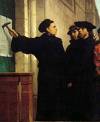
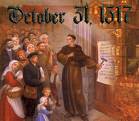
On October 31, 1517, the eve of All Saints’ Day, an Augustinian monk, hammered 95 theses—short propositions—on the Wittenberg door in Germany. He was protesting the indulgences of Tetzel, who, purportedly announced: "As soon as the coin in the coffer rings, the soul from purgatory springs.” This system of indulgences was part of the larger system of baptism and penance and the Mass. Each a step in the works-salvation method of Rome. If a shrewd Christian could find the right confessor and some money, he could cover most sins while living like the Devil. In fact, even civil punishment could be avoided this way (Works of B. B. Warfield, Vol. IX, Studies in Theology, “The Nintey-Five Theses In Their Theological Significance”, p.497).

Hammering the thesis was a public declaration. An advertisement of sorts.

But it was more. It was a formal declaration against the Papal and Romish supremacy in matters of faith and life. The various theses fundamentally attacked the Romish church’s authority over the matter of salvation. It dismantled the churchly machine of Sacerdotalism—that mechanical view of redemption integrated into the church. It was claimed that salvation was found only in the Romish church through the Romish priests and the Romish sacraments. Good works were instrumentally necessary for salvation. In short, it was a works-salvation system. And although Christ was formally part of the process, He was not part and parcel to the entire schema.

In contrast, Luther wrote: “Every truly repentant Christian has a right to full remission of penalty and guilt, even without letters of pardon.” (Thesis 36). That is, Christians can have full remission of sin without Romish interference (“letters of pardon”). The believer had direct access to God. He needed no other mediator than Christ. Warfield explain the antithesis thusly:

“The fundamental difference between the two doctrines [Luther & Tetzel] is the fundamental difference between evangelicalism and sacerdotalism. Evangelicalism casts man back on God and God only; the faith that it asks of him is faith in God’s saving grace in Christ alone. Sacerdotalism throws him into the hands of the Church and asks him to put his confidence in it—or, in the indulgences, very specifically the Pope.” (ibid, 499).

This view was summarized by Luther: justification through faith alone, by grace alone on account of Christ alone. It was a view that was earlier discovered by Luther’s study of the book of Romans (about 1515 AD). And it is the view underlining the 95 Theses:

“What he here attacks is just the sacerdotal principle in one of its most portentous embodiments—the teaching that men are to look to the Church as the institute of salvation for all their souls’ welfare, and to derive from the Church all their confidence in life and in death. What he sets over against this sacerdotalism is the evangelical principle that man is dependent for his salvation on God and on God alone—on God directly, apart from all human intermediation—and is to look to God for and to derive from God immediately all that makes for his soul’s welfare. In these Theses Luther brought out of the academic circle in which he had hitherto moved, and cast into the arena of the wide world’s conflicts, under circumstances which attracted and held the attention of men, his newly found evangelical principle, thrown out into sharp contrast with the established sacerdotalism. It is this that made the posting of the Theses the first act of the Reformation, and has rightly made October Thirty-first the birthday of the Reformation.” (ibid, 511).

[Next: The churchly and societal impact of the Reformation]
(entire series here)

----------------------
“But what things were gain to me, these I have counted loss for Christ. Yet indeed I also count all things loss for the excellence of the knowledge of Christ Jesus my Lord, for whom I have suffered the loss of all things, and count them as rubbish, that I may gain Christ and be found in Him, not having my own righteousness, which is from the law, but that which is through faith in Christ, the righteousness which is from God by faith.” Phil. 3:7-9

SDG

Monday, October 16, 2006

Christian Tribalism IV: Remedied


1 Corinthians 1:12 speaks directly to this issue of Christian tribalism:
For it has been declared to me concerning you, my brethren, by those of Chloe's household, that there are contentions [divisions] among you. Now I say this, that each of you says, "I am of Paul," or "I am of Apollos," or "I am of Cephas," or "I am of Christ." Is Christ divided? Was Paul crucified for you? Or were you baptized in the name of Paul? (11-13).


Thus, there was tribalism—“exaltation of the tribe [shared interests] above other groups”—an emphasis on distinctions implying an attitude of superiority—in the church at Corinth. Paul reprimanded this radicalization of distinctions. Unity and harmony should be the goal and activity of any church (local or regional) (Eph. 4:1-3). Men should not be the center of group-focus, rather the group should look to the base commonalities with the larger community in which it relates.


Not only should undue separation in doctrine and deed be avoided, mutual submission should be practiced (cp.1 Pet. 5:5).
Now I plead with you, brethren, by the name of our Lord Jesus Christ, that you all speak the same thing, and that there be no divisions among you, but that you be perfectly joined together in the same mind and in the same judgment (1 Cor 1:10)


In this passage we have the opposite of church-tribalism: internal and external unity. Internally we should be of the “same mind”—the same thought patterns, goals and ideals. Hence, the church is an organism. Externally, we should speak the “same thing”—the same confession, not merely in creed but also in deed. Hence, the church is an organization.


What this means is that as a member of the church, we should strive to submit to the greater unity of that church (locally or regionally). What this does not mean is a lost of identity in function or personality (1 Cor. 12). There is diversity within the unity. We will have differences (raising children, political practices, apologetic techniques, etc.), and even shibboleths (raising children, political practices, etc) but unless they are clearly in the Word and rise to the occasion of separation, they ought not to become issues. They ought not create a tribal-mentality in which that group of people and its goals, intents or ideals becomes greater than the whole of the church.


Is This Not Obvious?


It is not.


It takes much prayer. It takes discipline. It take humility. A ready admittance that "my way" is not always the best way. And even if it is the best way--so what?


Let us not forget Paul's admonition to the Romans:
"Receive on who is weak in the faith, but not to disputes over doubtful things...Therefore let up pursue the things which make for peace and the things by which one may edify another..." Rom. 14:1,19


Unity is little practiced in America. Even in Reformed and Presbyterian churches. Even within the same denomination! It seems at times that each church lives its own life in isolation from others. If this is unhealthy for individuals and families, then why not for churches? No church is an island.


We have to think outside our own selves, families and churches. We have to strive toward the unity that Christ bled and prayed for. We have to begin with humility and repentance from egotistical isolationism.


To defeat tribalism and to avoid being another illustration for blogger fodder, we must change our ways. And love one another, esteeming others higher than ourselves.


Pray that the Spirit would be pleased to do just that.


SDG

Friday, October 13, 2006

Christian Tribalism III: Illustrated

Proof is in the Pudding

We find some tribalism in the state. The state obviously manifests this infestation through the increase of special interest groups, compartmentalized bureaucracy, and fragmented visions of unity amongst the political parties (conservative Republicans, Reagan Republicans, Rhinos, neocons, etc.). Parties preach to the choir or yell at each other. There is no true dialogue. Our American system was purposefully built to be institutionally fragmented (three branches of government, bicameral legislation, etc.), but with the understanding of a common ideological underpinning. The former still exists, yet the latter exists is quickly fading. The center will eventually collapse with tyranny or anarchy as the result.

We find tribalism in the family. Whenever a family is suspicious of other families because they are not quite in line with their approach to life—whether in thought, word or deed—it may be tribal infestation. Whenever a family moves from church to church because they are “uncomfortable” with this or that of the church, it may be nomadic tribalism. Whenever a family teaches it own—verbally or non-verbally—that they themselves are virtually self-sufficient from other individuals, families or churches (even of society as a whole), it may be tribalistic egotism. It becomes family against family. A form of shunning may arise or gossip may be perpetuated to further reinforce group-think. They withdraw into themselves and only associate with those of the same core convictions—convictions not intrinsic to the Gospel of Christ. Rather, they are convictions rooted in legalistic shibboleths and antinomian idiosyncrasies. Eventually, it may mutate into a home-church: spurring any and all ecclesiastical bodies save itself.

We find tribalism in the church. Doctrinally (ideologically), people—even officers—have variations of beliefs and depending how tight they hold these beliefs they may be susceptible to tribalism. Differences usually do not surface until there are practical consequences. And differences usually begin in teaching hobby-horses and magnifying secondary and tertiary doctrines and practices. Communication between other churches is minimal because suspicion already exists, begetting less communication. Such emphases create homogenous churches (witness the church-growth movement). Does a church isolate itself collectively and familialy from other sister-churches? Does it not participate in other church's activities? Does a church unduly emphasize a person or position? Does a church preach unique views that result in pride and segregation? Does a church remain ignorant of its identity and relationship with others? If so, then there may be a bad version of tribalism afoot.

[Next: Remedy]


Monday, October 09, 2006

Christian Tribalism II: Defined

To understand this fragmentation and balkanization, tribalism must be defined. Webster summarizes thusly: “exaltation of the tribe above other groups” [or “strong in-group loyalty,” Webster, 11ed.]. In its more extreme forms, tribalism results in not only practical isolationism, but formal separation from the larger body. Now separation is a natural characteristic; many sub-groups, cultures, clubs and the like exist in America and have always existed.

Naturally, the church exercises a type of separation, but in a biblical manner. The church exalts Christ above all. It should have “strong in-group loyalty”—loyalty to Christ and to each other. Thus, in this sense the church is tribal with respect to the world, the flesh and the devil. The church is to be theologically isolated and cultural different (but not isolated completely). It draws its membership from the tribes of the world to be one (Rev. 5:9).

Tribalism in a negative sense means that prideful adulation of the sub-group over and against the larger group in which it exists. It thinks “we are better”; it says “we have a better approach”; it does its own thing in spite of the concern of the larger group. It is collective self-centeredness. It is rude and unkind to the very body which gave birth to it. It thinks of itself first and foremost and may consider others, if convenient.

Since the church-militant struggles with sin this side of eternity, there are many tribes within her—differing denominations. This is to be expected. And mature members and churches will handle such differences in love and rectitude. Such differences cannot be avoided, but they are aggravated when those groups or churches within a denomination begin to unduly exalt their groups interests, goals or ideals. Shibboleths arise; idiosyncrasies predominate; ecclesiastical isolationism ensues.


From this definition, the extent of tribalism may be more appreciated; it infects the political realm, the churches and even families. Clearly, any bible-believing Christian knows that pride—whether individual or collective—is wrong. Pride is more obvious in group situations because the number of prideful individuals is multiplied, creating a greater negative impact on others. However, it is harder to extinguish as well. The old saying that “birds of a feather flock together” has much merit and such a fact reinforces the group-mentality of tribalism: isn’t everyone else in my group on the same page? But the real question becomes instead: is this same page biblical? Should I or my family or my church make such a stand as to virtually place this page above the larger book of commonality found with other belivers?

[next: What it looks like]

Friday, September 29, 2006

Christian Tribalism I: Resurgence

I recently perused the latest edition of Wired. The article, “The Rise and Fall of the Hit”, caught my attention. It was an intelligent digest of how technology has recently mutated our relatively unified cultured (via the industrial revolution) into a niche market—a market more readily designed for organization around shared interests. Technology was decentralizing the culture.

In Neil Postman’s book, Amusing Ourselves To Death, he worried that the television would be the great unifier and sustainer of mass pop culture—a culture driven by the fragmented and disjointed running images of the boob-tube instead of a culture rooted in the coherent and rationale realm of the written word. His concern was that our culture was becoming more insipid and lackadaisical in its thinking processes, being fed instead with inane sound-bytes and drowning in a sea of amusement.

Neil is correct about the sea of amusement. What Neil had not realized (at least through that book) was the coming tribalization of America--a hi-tech tribalism. Technology further facilitated rising multiculturalism and fragmentation. Age-groups dominate the social scene with the Gen Xers emailing over vast distances while their Boomer parents complain about Gen Yers who text-message. Groups geographically isolated now connected through individual and mass media to further their agendas. People no longer are American or Anglican, they are Asian-American or Green-Anglican, creating new categories of differentiation that accelerate the sub-group’s distinctions from the larger community in which it dwells.

Another name for this effect is Postmodernism. With no epistemic-center in the system of many contemporary philosophers (otherwise known as post-structuralism), and especially the lack of self-reflective thought in most Americans, balkanization in American ideology and theology was sure to follow. Technology further enhanced such an approach through the individualization of tastes: don’t like what’s on the tube? Watch your own streaming video. Finding the radio to boring? Listen to your MP3 player instead. Is the local church too humdrum? Choose your pastor on cable or online.

Thus, technology has connected people who would have otherwise been separated geographically and economically. We can talk for pennies on the dollar with those we’ve never seen and we can disseminate our views with wider audiences via blogs. Hobby-horses connect world-wide with sympathetic ears; church members follow sly blogged innuendoes instead of their own church leaders; families withdraw from local friends as they connect with those far away; ministers grow distant with their own presbyteries while bonding with outsiders. In short, we begin to fragment and tribalize.

And this modern balkanization has wormed its way into the various God-ordained spheres of life: family, church and state. It has existed in small forms over the centuries (compare Anabaptists & some Fundamentalists) and, through the help of current technology, is in resurgence today—albeit in more subtle forms.

[Next: What it Is]

Monday, September 18, 2006

A Short Review 8: Ready to Restore

Ready to Restore: The Layman’s Guide to Christian Counseling, Jay Adams

The subtitle says it all: this is an immanently useful and practical book for anyone desiring to grow as a Christian. Why do I say that?—Because we are all commanded to admonish one another in the Lord and to bare one another’s burdens (Col. 3:16; Gal. 6:1-2). This, of course, is what every good and faithful friend desires. And Adams supplies the guidelines and principles straight from the Bible for every believer’s use.

With the relatively large number of chapters and small font, this book may intimidate some and turn away others, yet Jay Adam’s irenic and simple style is conducive for a quick read—especially on a chapter-by-chapter basis. The author first starts out with the basic questions about who should counsel and what counseling actually entails (chapter 1-3); he then encourages the reader that he can and should learn to counsel (4). Chapters 5-14 are the heart of the book, expounding and explaining the details of a biblical and practical approach to counseling. The remaining chapters focus on the counselor’s own growth and any typical questions and problems one may face in a counseling situation.

Amongst the many useful aspects of this book are the twenty-five basic counseling principles (p.32), the analysis of ‘self-esteem’ and the Biblical corrective (p.55) and the simple two-fold solution to problems: helping someone out of a problem and keeping them out of the problem (p.57).

Ready to Restore is an excellent book for every believer in Christendom. In trying to teach yourself Biblical and Reformed counseling, you not only help other through their difficulties you learn to grow in Christ as well.

Monday, August 28, 2006

Man is Evil—Lessons From Katrina Part 3

Homosexuals throw a street party while thousands suffer.
Corrupt politicians ignored the levy problems for decades.
Now they promise to help those whom they destroyed.
Looting occurred almost instantly.
Rescuers were being attacked and harassed.

There are one million and one examples of the wickedness of man. The refuges are angry, bitter and irate. As they lash out at the local, state and federal governments, they rage not against man but against God. God is in control. And the government is not God. No matter how prepared they could have been God’s will would have been accomplished.

Seeing the awesome might of Almighty God brush the Gulf Coast away as a sun eradicates a moth, they acknowledge Him not but flee to man for refuge. Such an event is to show God’s wrath and man’s sinfulness. It has done both. But the church also has a job to proclaim these truths. Instead, as the American churches are wont, they send monetary help without Gospel help. They shy from uttering dark pronouncements lest they appear “negative”. They shirk their prophetic responsibility being uncomfortable with the prophets of old:"The heart is deceitful above all things, And desperately wicked; Who can know it?” (Jer. 17:9).

According to the buoyant proclamations of the likes of Sean Hannity (a Roman Catholic), these devastations were to bring the “best out of the American people.” But if one examines a little closer with the eyeglasses of the Bible, one rather finds the manifestations of evil: men and women shaking their fists at God while helping their fellows rebuild their engines of destruction against the Kingdom of God.

If the churches in America would be true to their calling, then as servants of God they must, “in humility [correct] those who are in opposition, if God perhaps will grant them repentance, so that they may know the truth, and that they may come to their senses and escape the snare of the devil, having been taken captive by him to do his will (2 Tim. 2:24ff.).

They will not feel sorrow over their rebellion if they believe there is nothing wrong.
They will not cling to Christ if they believe themselves good.
There are one million and one reasons why men should repent. The obvious and easiest reason is the first one: man is evil.

SDG